Thursday, 26 September 2024

Breaking the "Rules of Street Photography" - Part Two: Street Photography requires People as the Primary Subject

This is the second part of my "de-bunking Street Photography Myths" series of rants.  The first one is the one I run into the most and that is about using a Prime Lens for street photography; however I am covering two more subjects I hear a lot that "Street Photography Is/Must Be" which I am going to de-bunk. So let's get on to Myth Number Two:

Street Photography Myth #2: It's not Street Photography unless People are the main focus of your photos you post.

Just like the first topic this one is pretty bogus as well.  Some people will make it their entire focus to perceive street photography as just including either candids of people on the street or street portraits, IE a posed shot on the street where you identify yourself or someone comes up to you and asks for a photo.  

Before I begin on my rant, People are a very important subject of Street Photography and this post is not intended to make this seem otherwise. 

I fully understand why people will make people the main focus their photography on the street as I do it myself from time to time.  It is very easy to make an emotional storytelling photo of some street musicians playing for a small audience for example, and if I saw that happening oh yes would I very much get that shot.

Photos with the focus on people, whether crowds, candids or street portraits makes up for 25-40% of my street photography.  Which means they are a significant subject and I will not ignore them when given the opportunity to take a shot that incorporates them.  But that other 60-75%, what does that entail?

When I am on the street my photography is focused on whatever catches my eye.  It could be people yes, but it could also be cool old architecture, signs, urban wildlife or domestic animals (IE a cat in a window), window displays, old cars, graffiti and street art, stickers, colorful fabrics, neon lights, etc. 

The list of different interesting things you will see in an urban area; whether in a small town, regional city or downtown metropolis will be vast and include more things then just people.  Street Photography is about capturing "the influence of man" but that does not mean that humans have to be in it.   

This ranges from taking architectural shots of bridges, buildings, to how nature adapts in an urban environment to traces humanity leave behind which are often symbolic; this ranges from Street Art, graffiti and stickers to objects that have been left behind in a purposeful way such as a pair of gloves, or a small collection of items arranged in a pattern on a table or sidewalk by someone.

There's another type of photography that can very easily tie into street photography and that is Liminal Space photography.  People have published entire books on this subject alone.  

Typically Liminal Space photographers will target abandoned places such as a dead boarded up mall, a dilapidated gas station that has been abandoned for years, or sneaking inside an abandoned Chuck E Cheese where the animatronics are still intact.  This falls under the umbrella of Urbex Photography, a subject I am fascinated by but rarely have done due to the legal gray area partaking in this subject of photography requires.

However you can also get Liminal Space photos from street photography and not dangle in that legal gray area and its easier then you think.  Go to a small town that may be less active in an "off" season during a slow time of day such as a Sunday Morning during "Church Time".  You'll often find vacant streets during this time that are a Liminal Space photographer's dream and can legally take photos that show a very prominent "hand of man" influence without anyone being present. 

I can recommend doing this as exercise for anyone who wants to get better at Street Photography; not only does it build up your confidence going out on a day when there is very little chance of being confronted by someone but it also trains your eyes of what to look for in a city and what is going on in the background that you might otherwise miss if you are just going around taking candid photos of people all day.

So let's move on to some examples of the "other subjects" that combined make up a higher percentage of photos for me then just taking photos of "people on the street".  If there are any people in these photos they are well in the background and blurred out, so the focus of the photo is clearly not about them (and you need to pixel peep to even see that there is people in the frame).


Street Photography Subject #1: Architecture and Liminal Space

In an urban area the first most noticeable objects are not the people but the buildings and architecture mankind has created to permanently alter the environment to suit their own needs; whether residential, office businesses and industrial facilities, entertainment or commerce or even the infrastructure for transportation itself IE roads and bridges.

This subject is very easy to adapt to street photography, and generally when people ask me "what I am taking photos of" my canned response is "I enjoy taking photos of old buildings".  

Stating that you are taking photos of old buildings is generally an acceptable answer to the intrusive question and can even be an icebreaker that will either get them to move on or start a small side conversation about the town and its history and some interesting places to go visit. 

Architecture and empty street scene photography is one of the easiest forms of street photography to capture.  You can take as long as you need to compose your shot, just make sure you pack a wide enough lens on a quiet mostly peopleless day and this type of street photography is really easy.  

People, if present become background elements and the subject become the street scene itself' the focus shifting to towering skyscrapers or an outdoor patio outside a small restaurant.  This is a solid subject to use to as an icebreaker to get into street photography with.


Street Photography Subject #2: Urban Wildlife and Urban Nature

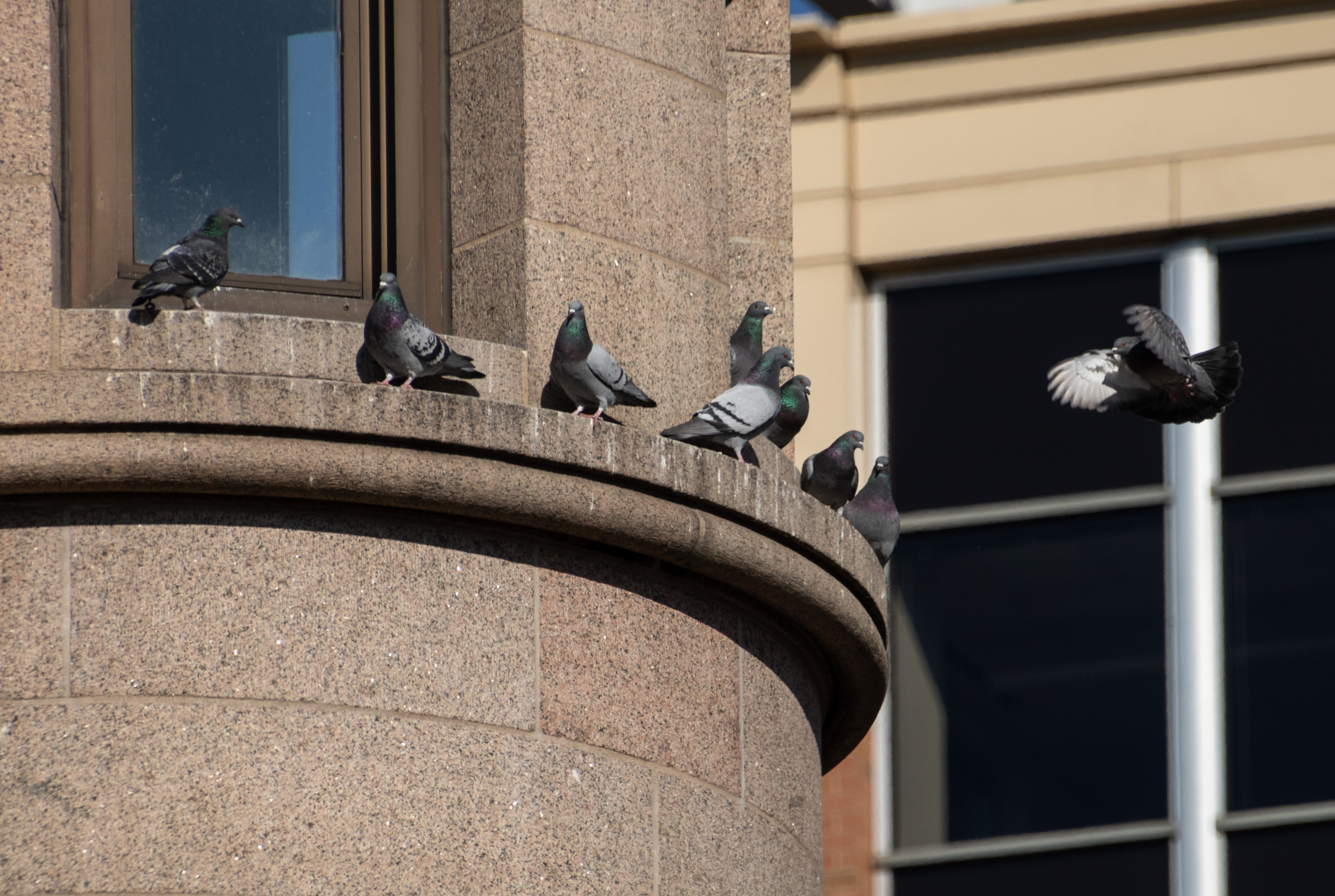
One of the most overlooked aspects of Street and Urban photography is how Nature adapts around mankind's influence.  This ranges from trees planted in a park, crawling vines on the side of buildings, weeds and of course wildlife itself that has adapted to fully urban settings such as birds, squirrels, insects, rabbits, raccoons etc.  

Urban nature is not a subject I am able to capture on every street photography outing (as Urban Wildlife is still often wary of humans) but is one I prepare myself to be able to capture when it presents itself as it can often result in some very unique and contrasting photos.


Street Photography Subject #3: Street Art and Graffiti

Another obvious hand of man subject is Street Art.  This ranges anywhere from sculptures the city has created, to murals painted on the side of building down to grafiti that some teenagers put up to post a message.

This is a subject I want to do more of, unfortunately much of the more interesting street art and graffiti in my area is put up in higher crime areas of the major urban center that I do not feel comfortable visiting alone.  That said, I have still found plenty of it in my travels and always make a point to capture it when I see it.


Street Photography Subject #4: Signs and Stickers

Similar to street art and graffiti, signs provide a human element and a message one which has been tailored to a specific purpose such as advertising a business or event to spreading awareness of a specific subject or even just leaving a message.  Unlike Murals however signs and stickers are often more transient and easier to remove if a business goes under, an event ends or the city decides to clean up stickers placed in various places.

Signs have always had a special place for me in street photography as they were the first subject that really drew me into doing it. Yes, the first subjects I took photos of on the street were "funny looking and weird signs" and not people, as it took time to gather the courage and learn some tactics of taking candid photos of people without having a lot of confrontation to go with it. Sign photography was my gateway into street photography.

Signs do not get offended if you took a photo of them, so just like Architecture I found this as a safe anchor to fall back on when out in the street with a camera and people ask me what I am taking photos of.


Street Photography Subject #5: Vehicles

By definition "streets" are designed to move vehicles that carry drivers and passengers from bikes and cars up to busses and light rail trains. Classic and unique vehicles found on city streets can make a fun subject to work with, but even more mundane transportation such as bikes and mass transit vehicles can still make fun subjects on their own without any drivers or riders when taken at the right angles.


Street Photography Subject #6: Window and Street Displays

One of my favorite subjects for Street Photography are store displays.  These are most common in small towns and rural regional centers whether the product is behind glass or on the street for passers by to look at.  Many of these displays will often be arranged in a way where it is a work of art in of itself which is why I always stop by glass fronted businesses as I am out to take photos as I pass by.


Street Photography: Other Non-Human subjects

I could make this into a book if I were to list every possible subject to street photography that doesn't involve a person, so after giving the major subjects I will look for to anchor myself on the street that aren't people here are a few other subjects that you may encounter while doing street photography that are worth stopping for and snapping a photo of:

  • Domestic Animals without a owner on a leash (such as cats in a shop window)
  • Objects arranged in a pattern
  • Trash and "Lost" items like gloves, glasses, etc
  • Construction Zones
  • Utility features (street lamps, fire hydrants etc)
  • Sport/Recreational Equipment
  • Flower Planters
  • Wall and Door decorations


To sum up this entire post, I feel that people miss out on a lot if they only view Street Photography as photos that include a person as a main subject element.  By restricting yourself to just taking photos of the people who were there you are missing the opportunity to document your surroundings as they change.  

Not only will this limit you to how many photos you will take when you are out, but you will also miss a lot of different things, some quite obvious like vehicles and buildings, and some more subtle like window displays or lost items that are just waiting to have their image taken as you journal your daily life in photography.

For me, that is one of the big draws to street photography as just like travel photography you are documenting what you see from your perspective, the only difference being that with travel photography you are doing so at a new place you will likely never or rarely return to; whereas street photography can be done at a place you frequent.  

You may take a photo of a restaurant, and a few months later it is demolished and nothing but a hole in the ground.  Or you may take a photo of a window display with a Christmas theme and 6 months later its showcasing mannequins in bikinis.

For me, this constant change is what keeps me drawn to street photography.  Every time I go out even if its to a spot I've done street photography at dozens of times there is always something new and different to capture.  If I stuck to just one subject I likely would not see many of these differences, and would have less drive to return to an area I had already been to.


Wednesday, 25 September 2024

Breaking the "Rules of Street Photography" - Part One: Shooting Street Photography only with Prime Lenses

I've talked about Photography snobs in the past, and did an entire post on Gear snobbery and "Gear Gatekeeping". During that post I also touched on lightly on other types of photography snobbery and there are a few I want to address in their own posts.

The next form of Photography Snob I am going to focus on one of the forms of a "Purist", and that is a Photographer who thinks you can only do Photography or atleast Subject X of photography with a very specific set of equipment, settings, composition etc.  

For me, one of the most absurd subjects to be a purist on is Street Photography, yet it is one of the most common topics that hobbyist purists pour out of the walls to die on trivial hills to defend their "Holy method for shooting street". 

If you go on Youtube there are dozens upon dozens of videos all with slightly different opinions that you need X things or you can't do street photography; but many of them share similar rules which I will identify.  

Over the next three posts I will narrow this down to three purist street photography Myths I find common in a lot of these videos.  This post covers the first Street Photography Myth I run into:

Thursday, 19 September 2024

Mirrorless vs DSLR. Full Frame vs Crop: They're All Valid

It's been awhile since I've written anything on this Blog.  This is due to having busy summer out taking photos, spending time with friends and work has kept me busy with projects leaving only a few very rare days (like today) where I am sitting at the office waiting for replies to things I sent out without much else going on.

So to get back into the swing of things, I thought I'd touch base on two topics that are often lumped together when you try and talk to other photographers or camera stores to decide "What's a Good Camera" and that is a crop sensor vs a full frame sensor and a mirrorless vs DSLR.  I have touched on both on their own in the past but the line for most people becomes blurred that they need both "Full Frame" and  "Mirrorless" to have a good camera; and only having one of those somehows makes their equipment inferior.

Before I get too far into this, know that at the time of writing this I do have a Full Frame Mirrorless camera ordered and being shipped; a Nikon Z5 which I will likely do a seperate review on when I get a chance to go out and shoot it.  

Most people would be in the Mindset of "Well you just upgraded to the best so you should just get rid of your old equipment" but for those who have read my Blog know, this will NOT be the case for me.

The Z5 will be a tool, specifically used for Indoor Event Photography as its primary purpose.  It's also a complimentary camera to the Nikon Z50 I own which I am NOT just trading up to (and keeping both) and still cannot say enough good things about that little lightweight powerhouse of a camera.

For Event Photography I always bring two cameras: a Primary camera and Secondary camera which is often smaller and act as my sidearm for when I just want to run around with a prime lens and take some quick wandering photos without being weighed down by 20 lbs of equipment.  The Z50 and 24mm DX 1.7 prime fit this sidearm niche beautifully.

When I was shooting my last indoor event a few weeks ago, I had brought an APS-C Mirrorless and a Full Frame DSLR camera as my two cameras I brought with me; my Nikon Z50 and the Nikon D610.


The one topic I will not cover nor debate in here is "High ISO Performance".  This is always what people jump on "You must get Full Frame to be good at this"when it is often a Myth and never an Absolute.  

Some APS-C cameras such as the Nikon Z50 and newer Fuji X-Trans sensors are incredibly good at High ISO noise to a point where it can be a lot closer to a coin flip between what an entry/mid level FF camera can pull off vs them.

Tuesday, 18 June 2024

Pixel Peeping: The Eternal Struggle of Digtal Photographers

 Those who follow my Blog know that I have a hobby collecting different cameras.  I enjoy shooting with a lot of different equipment especially that which is Older, strange, or just otherwise an "Underdog"/somewhat underappreciated camera that most "want to be Pros" would write off as rubbish.

But from time to time, I will get a new camera, a new lens that is "better" then what I had before and start to pixel peep.  I'll find an image that was shot at really high ISO, under less then ideal lighting and then be blown away by how sharp it is on the pixel level, like being able to see fuzz on an insect, individual hairs on an animal's fur or strands on a plume of a bird's wing.

I've tended to notice as of lately I've become this way around one subject in particular, Nature photography.  Constantly zooming in to pixel level to see how much noise or lack thereof and detail is there.  Finding myself asking "why is this camera/lens inconsistent?  Is there something wrong with it?  Getting really high pixel level detail shots like these:


Then comparing those shots to other photos, taken with a lower or even "Native" ISO and wondering "Okay why do these look so much worse?"


Some of this is for sure due to the lens or the sensor. Some of it is due to the distance the subject is from the camera, lighting conditions, etc.  So when you hear people talk about "Low ISO= Low Noise" well its a general and not absolute. 

Same goes with focusing.  A lens/sensor combo which can be tact sharp and spot on with the focus in one situation may really struggle in another.

This is, in large part why I take so many photos.  I will often double tap to make sure I got "one good shot" even when using my most modern, most expensive camera system.  Its a hard habit to break.

Even with doing that, I will still get plenty of photos that are "almost good" that at the time will look fine when I export it, but then I look back and go "dear god why did I post this photo online?" a few weeks later.

Then I flip flop, and when I zoom out and am not "pixel peeping" the photo looks fine.  Even the "bad photos" I posted above look great on my phone which, lets be realistic, is where most people viewing my photography are going to see it from.  They are also not likely to be as picky as me.

However, the biggest take away is when I am no longer peeping at the pixels on photos I worked to "save" and then just got frustrated and said "That's good enough, I'm going to post them anyways" at full resolution, without looking at the pixel level they look a lot better:


Before we get into "Well you wouldn't be unhappy with Pixel Peeping if you shot a $5000 full frame body and $3000 lens!!!" let me just quash this right now by saying I've got some really incredible shots on cheap-entry level gear then struggled with having "quality issues" on photos from my higher end stuff. 

When I get really nice sharp photos on older gear, I'm happy and impressed, and when I get less perfect photos off the same camera I'm not as concerned about it.

But when I shoot with a $600 body and $1200 lens (which to me is a LOT of money.  That is on the absolute limit of what I can afford) and get a few images that are terrible to mid at best; then I question if there is something wrong with that camera or lens.

Maybe the lens has a haze issue, maybe the AF sensor in the camera is on the fritz, maybe the lens' focus motor itself is starting to die, etc and begin to visualize what this photo would have looked like had I made a different decision and had invested my hard-earned money in something different instead.  

I've traded in lenses for this very reason only to find out later that the new lens really made very little discernable difference in the consistency of my photos from that camera; remaining to be "some photos are very good, some photos are still bad".

So yes, it very much becomes a rabbit hole with no bottom.  Unless you are extremely wealthy, there will always be a better camera out there then the one you are using.  

There will always be "better" lenses too.  However even those cameras and lenses can still take photos that are just as terrible or in many cases worse then the photos you are pixel peeping and wishing it was less noisy, details weren't so smudged, or it wasn't just a hair out of focus.

As a photographer its hard not to Pixel Peep.  But you need to remember: "Artists are often their own worst critics".  

This applies wholeheartedly to Photography as well.  A photo you are pixel peeping that you think is blurry, not tact sharp or has other issues on the pixel level that looks "perfectly fine" zoomed out to what you are displaying on a phone screen may become your most popular, liked and most commented on photo you've taken; over the photo of a frog where you can see every bump on its skin. 

It can, and does happen.

Friday, 10 May 2024

Panasonic FZ80 Review

 Last year I shot and reviewed 52 cameras in one year (one every week).  It was a monumental task and now I've mostly been using this Blog to ramble about my thoughts about Photography in general and camera technology in general. 

I do enjoy doing these camera reviews and since there are far far more then 52 digital cameras ever made (think more along the lines of tens of thousands; far more then I could ever hope to review) and add to that there are some digital cameras so incredibly rare that they are priced well out of the funds I have to dedicate to my digital camera collecting hobby.

The camera I am going to review today is neither Old nor Rare.  It does mark the swansong era of the late 2010's with the end of the Bridge Camera; an odd niche camera for most to use in the current age as it doesn't have detachable lenses nor can it fit into a pocket.  

Bridge Cameras often try to be "prosumer" and offer some of the features found on higher end DSLR and MICL cameras, but at the price of having lower end pocket camera responsiveness and handling which I may delve into later as I could easily do a follow-up article just about the concept of bridge cameras and how they evolved and eventually met their demise.

I could ramble on and on about the history and evolution of the Bridge Cam; so that will likely be done in a seperate post. For context purposes we'll still identify where bridge cameras, the FZ80 in particular excel and where they fall short during the review.

So now, lets dig into the camera in this review, a late model Bridge Camera the Panasonic FZ80.


Before I get into the review I should preface this by this camera being currently on loan to me by a local fellow Digicam collector and enthusiast (who I have parted ways with several cameras with and also acquired several from). 

It's a neat camera but isn't one that I am currently oogling over and feel I need to find one for myself to keep at the price-point they currently sell for, and I'll discuss why later in the review.

Released in 2017 the Panasonic FZ80 was one of the last Bridge Cameras ever made alongside the FZ2500 and the Nikon P1000 a year later.  These cameras are new enough you can still buy them brand new in a box from retailers; which pushes the resale value for a used one higher then I'd want to pay for one at the moment.

It has a fairly standard 1/2.3" 18mp CMOS sensor, as most modern bridge cameras use a small sensor like this for the crop factor to get a superior optical zoom; allowing Panasonic to take a 200mm or so optical focal length zoom lens and translate it into "1200mm equivalent" with the small sensor that provides a 5-6x crop factor.

Much like the Nikon P1000 it uses this sensor along with a fixed super-zoom range zoom lens to give users a larger amount of Optical zoom then their phone or even in many cases DSLR would have without lugging around a 5lb lens. This was the one redeeming and selling point for these late model bridge cameras: you could zoom in to your hearts content and capture things at a distance in a lightweight goes everywhere package.

There are a few exceptions like the RX10 and Panasonic FS2500 which offer a 1" sensor instead; but the last real niche for the bridge cams from Fuji, Nikon and Panasonic into the 2010s was to pack as much optical zoom as possible into a relatively compact and lightweight camera with a fixed lens that anyone could easily use.

Turning the camera on there is a short but not terrible startup delay.  It's about in line with what I'd expect from a pocket camera; and fast enough I can still do hipshots in Street Photography without fully missing the moment.  

This delay is more noticeable when you try and do Nature photography. This tends to be the whole package of taking a photo however that is overall slower that will make you miss fleeting moments, from turning the camera on, to waiting till the optical zoom extends, and then dealing with a fairly sluggish AutoFocus system lock onto the subject.  

The Panasonic FZ80 is defiantly more responsive and quicker overall then many pocket cameras; but this still leaves it slow enough you can defiantly tell a huge difference after you've been shooting a DSLR or MICL camera.

Controls on the FZ80 are fairly basic.  It was definitely engineered with the casual shooter in mind.  It does have a single function wheel which you click in to toggle function of such as using exposure compensation vs holding another button down and spinning the wheel such as with entry level Mirrorless and DSLR cameras.  It's a design I don't mind but did find confusing as my brain was always trying to hold down the nearby AF switch FN button and spin the wheel to adjust shutter speed in Manual or exposure comp in AV, SV and P modes.

The Panasonic FZ80 does have three programmable FN buttons which is actually a lot more then most consumer bridge cameras offer: two on the top and one on the back which doubles as the trash button.

The lens on the FZ80 is remarkably sharp and low distortion for the entire focal length; but with a tiny image sensor it does not show distortions and imperfections in the glass as much.  It's a huge improvement in optics over any smartphone lens and a slight jump from what is offered in a lot of point and shoot cameras. It does have some Bokeh smudging and Chromatic Aberration (which you can see in the photo of the owl later), but overall the actual optics of this camera are pretty solid.

I did manage to get some pretty nice photos off of it so far, a few I will share SOOC and two edited pics which I will show at the end when I get into RAW editing and overall tldr on my thoughts.  I really haven't tried using this in anything outside of bright outdoor lighting; but since I know from past experience this is where all tiny sensor (smaller then 1") will fall apart, I felt it wasn't useful to add that in the review and just cover examples and instances when I was able to keep it under ISO 400.

One of the main thing the FZ80 lacks (which is sadly very common in bridge cameras) is a control wheel around the lens element.  This feature is standard on any focus-by-wire MICL lens (albeit not able to do anything other then manual focus in this case with a few exceptions namely Canon).  

The lens control wheel in premium pocket cameras such as the Olympus XZ-1, Canon Powershot S90, Panasonic ZS100 and ZS50 are really nice to have and make fine-tune MF on a subject a lot easier to do.  It is the one major feature that would likely sell me on bridge cameras like the FZ80 more if more modern bridge cameras had this feature even if it could only be used when the camera was in MF mode.

In terms of Optical Zoom IE the big selling point to this camera; what you gain from this camera over a superzoom pocket camera like the Panasonic ZS50 or Canon SX720 isn't nearly as much as the "numbers on the camera" leads you to believe, which is a big part of the reason it isn't higher on my list to purchase.  For an explanation of why that extra "30x" more zoom is really deceiving I've got some examples.

First off here is the lens at the widest setting which Panasonic states as 20mm FF Equivalent (but I feel like is actually more like 24mm; still fairly wide for a fixed lens camera)


Zooming into 30x which is where the Panasonic ZS50 tops out you can see a huge difference, and up until this point every little tap of the zoom lever has a noticeable effect:


When you push past this halfway point the optical zoom seems to "slow down" as it were, and holding the lever all the way to the end at 1200mm makes it feel like you really only got an extra 3x zoom out of the lens vs the 30x additional you were expecting.  

One would think that being at 60x zoom I could clearly read how much gas is per gallon on that pump there right?  Well...  that isn't the case. Here is all the more zoom you get from the pocketable ZS50 to this not so pocketable bridge camera, not that much at all.


Had I not already had something like a ZS50; something like the Panasonic FZ80 would be a lot more appealing.  Ultimately the ZS50 has similar output, low light performance, dynamic range and sharpness to the ZS50 and lacks the second programmable control wheel (that the FZ80 lacks) around the lens, and most importantly I can throw the ZS50 hard case and all in my jacket pocket.  

The extra 6mp on the sensor (12mp on the ZS50 and 18 on the FZ80) likewise does not get me as much real-estate as one would think either; and if I felt this resolution bump was what was holding me back I'd rather just upgrade the ZS50 to the ZS70 which jumps to a 20mp sensor in the same compact form factor.

In addition the size of a bridge cam like the FZ80 means needing to carry a small bag when not in use and while its lighter and more discreet then my mirrorless cameras still it fits a niche I don't often find myself needing and  I own older bridge cameras should the urge to shoot a bridge camera arise such as the Sony F828.

Overall the FZ80 hasn't been an experience that makes me feel the desire to go out and buy one of my own, especially as they still sell for over $300 Used.  For 1/3 of that price at around $100 I can get a used DSLR or older Mirrorless camera that is a lot more responsive with better image quality and superior analog controls. If the camera was under $50 sure I'd still think it was worth that to have one in my collection but I don't see this happening any time soon. And for that $300 I could upgrade my ZS50 to the ZS70 or just about buy a used ZS100.  Seriously, IMHO the ZS100 would be a much better use of that money.

So while the Panasonic FZ80 may not be a great fit for me and I don't feel any specific attachment to it especially after the realization that the "Double amount of Optical Zoom" in reality is only about 10% more; the Panasonic FZ80 still gets really nice photos even Straight Out of Camera. Add the fact that it can shoot RAW (which is something I like about Panasonic in their cameras over Canon on any pocket or bridge camera they released after around 2010) makes it have a fairly solid dynamic range potential which I do have an example I will share later.  For now lets start with the Straight out of Camera un-edited photos I took doing Street Photography at a small town in WI the other day:


Nice colors, fairly accurate exposure metering (even with subjects like the robin that were in shadows which is pretty impressive), and plenty sharp.  There really isn't a lot to say bad about the SOOC results with this camera. Someone who knew nothing about photography could easily take this out, zoom and shoot and have photos that are as good or better then what their phone could take with a reach much longer then what the limited lens on their smartphone couldn't achieve.

The real hidden strength of course is that the FZ80 can shoot RAW.  This is a real full Camera Raw file with all the information included and not the less featured "DNG" format that the Pentax Q10 and various Smartphones can shoot at along with "hacked" Canon Powershots using the CHDK utility.  I have two examples of edited RAWs from this camera, one which I can compare to the original image:


And the final image after some fairly heavy tweaks in LightRoom:


To end the review, here is one more photo on a subject that pushes the camera's limits.  This was taken at the full 1200mm of an Owl under very dark overcast skies.  If I was using my Panasonic G9 and $700 100-400 zoom lens I still would have had challenges with this shot.  

The original which I do not have handy was 1.5 stops underexposed with severe chromatic aberration (thanks to tree branches against a white sky, which you can still see some of- it was way worse before editing). I think it cleaned up pretty well and while it may not be something you would see on the cover of National Geographic but most people would be more then happy with a photo like this:


Tuesday, 7 May 2024

CCD Magic- Yes it Exists but not everyone can see it

There's a huge Hot-Potato debate going around everywhere on the internet since things "opened up" from the Pandemic, and that is "are CCD sensors Better then CMOS/Modern/Smartphone sensors?

In late 2022 as the world moved out of their Vault-like lifestyles and began living again many people, especially young people who had part of their impressionable months or years locked away from their friends behind a mask, looked for new Hobbies to explore.

For a large number of Zoomers, one of the prominent hobbies that exploded during the beginning of the "Post Pandemic" era was Photography.  Teenagers and young 20 somes decided to put down their phones and look at the world through the lens of dedicated cameras instead, but the twist of this is: they didn't hop over to Nikon/Sony/Canon (albeit a lot did jump over to Fuji but that's a different subject for a different day) and buy the newest greatest Mirrorless cameras.  No, they did what I have been doing since 2018:  Seeking out the Digicam.

In part this post is going to be Elder Millennial defending these Zoomers because for once its something we actually share in common.  I may not have any interest whatsoever to play Fortnite or be bawling tears because the US is going to join several other countries in finally blocking a major Security Risk on the internet (TikTok) but I can appreciate a common ground when it comes to Digicams.

Then there are those who "fighting back against digicams" on various channels on YouTube and other Vlogs/Social media.  Most of these people are from two crowds:  Film Hipsters (who believe that people are viewing Digicams as "Better then/same as Film" and I can see why they feel defensive over that).

On the other side of the anti-digicam team are the more "Serious" photographers who of course want to validate the thousands of dollars they spent on equipment and thus are going on a crusade to stamp out "Inferior Digicams" so will go full on the defense of why their $5000 Full Frame MICL is better etc etc.

I've done several posts regarding "Gear Snobs" and why they grind my gears.  So I am not going down that Tangent in this post.  

Needless to say you've got two camps of people just as you did with the Film vs Digital movement that started around the mid 2010s (and is still ongoing): Those for Digicams and those attacking/against them.

Let's clear the air right now by saying one truth about Photography that has been a long standing point of this Blog:  Photography is ART.  Art is Subjective.  What looks great and amazing to one person is going to look terrible to someone else.  

In that sense no, your $5000 Sony MICL Full Frame Monster is not "Better" then the person shooting a 60 year old Medium Format Film camera nor is it "Better" then someone shooting a Vintage digital camera with a CCD sensor in it. It is just "Different" because to an artist will paint with the "canvas, brushes and paints" that look the best to them.

Another example of how a Photographer can use a different tool to get some really unique results is from online friend of mine recently 3D printed some pinhole lenses for their modern Sony APS-C MILC camera.  They cut out a lens from a disposable film camera and put it into this 3D housing for a homemade lens that got some really cool effects. I may do a seperate post about this sort of "experimental" photography though my experience with it is pretty limited (as of right now anyway).

Because of the premise that Art means embracing differences I am going to state that CCD Magic or even Film Magic is not and should not be considered "Better" then a Modern MICL Camera, nor likewise is a $5000 MICL camera better because it costs more and is new.  It's all about being different and that is what makes the Magic and makes the Art.  

If your Film gives a different look to a photo then a Sony A9 with a $8000 lens slapped onto it that is where the Magic is.  Art should be about what looks aesthetically better to you and will vary person to person. It's not about staring at a zoomed in at full pixel level to determine "which image is more technically better because it has less sensor noise".

I'll admit, I've even committed this Digital Photography sin more then once.  It's extremely common when I am doing Nature Photography.  But maybe in that one case yes I do need that tool with the better camera and the better lens because I am looking for a very specific look.

So putting this into context the question becomes not "Is Photography with CCD sensors Better?" to "Is Photography with CCD sensors different?".  That will determine if the Magic or Art is different with different tools.  In my opinion it is; but not everyone may see the difference.

Rather then ramble on about the science and technical specifications I'll provide some examples from 2 different CCD based cameras and 2 different CMOS cameras.  I am sticking to APS-C DSLRs for my "Test group" simply because the lenses I use on these cameras are the same.  I will also be throwing in a curveball at the end with the Fuji Super CCD sensors; but for now let's put two single layer CCD sensors vs two Single layer CMOS sensors.  

I wanted to keep this initial comparison small.  I could have easily thrown in a 1/2.5" Canon Powershot CCD sensor into the pot along with the unique properties of the Sigma Foveon sensor; but that sensor is unique enough it really deserves its own post to explain just how different of a tool it is.

Smaller sensors, Vintage Digital and Digi-cams will likely get their own future blog post, because I feel there is enough to cover just in the CCD aspect alone to put two comparable cameras with different technologies toe to toe and show off how it can differ.

In the APS-C CCD Corner we have the Sony a290 and the Nikon D200.  And in the CMOS corner we have the Sony a37 and the Nikon D7000.  Color science is a little different on newer cameras, so I thought it was more appropriate to keep this limited to cameras older then 2015.

These photos have been touched up minorly in post.  Mostly for exposure and sharpness.  Contrast, white balance, and contrast were mostly left alone.  I may do a SOOC comparison for a more "clinical" approach to this at a later date but for now I am just using 4 photos I really like shot on each camera.

First up for the CCDs the Sony a290:


Compare this to the Sony a37, a very similar (16mp vs 14mp APS-C) but CMOS sensor:


And now we move onto the Nikon camp.  Nikon uses Sony sensors.  So maybe the argument is we are only comparing Sony Sensors to Sony Sensors but I digress.

Nikon D200 (CCD)


Nikon D7000 (CMOS)


Overall in my personal experience the Sony a290's sensor is so vivid that it really steps ahead of the pack even over the D200.  It's a camera limited in so many ways and can be very frustrating to shoot but when I see how the images turn out I wind up holding onto it tight for well reasons.

The Nikon D200 is more subtle of the "CCD Effect" but it is there if your eye is trained enough.  Likewise the a37 and D7000 (which use similar 16mp APS-C CMOS sensors) have a more noticeable orange/yellow shift overall.

To sum my thoughts up: every camera sensor whether it is CCD or CMOS will have a different look.  They all have slight differences in how the processor outputs the data it receives and differences in how the photsites themselves capture light.  

So yes, there is merit in also saying the Canon 5D classic will get a more "Classic" or different look then a Sony A7 is valid as well since even though they are both Full Frame CMOS sensors they have different processors and way they output their files, yes even in RAW they will look wildly different.

Putting everything up to this point aside, many people may not be able to see much of a difference at all between different camera sensors;  Old, New,  Full Frame or Smartphone Sensor, CMOS or CCD.  

Many will see all of these photos as the same or "equally as good" and that is fine.  There are some factors that can influence not being able to see these subtle differences as well. 

For Example:  If you look at these photos on a standard computer monitor you should see some differences.  If you look at them on your Phone or a tablet however: those devices have vibrant OLED screens which tend to "even out" colors and contrast to make any photo taken with just about any camera pop and look good.  

That may be a reason why Smartphone photography is so hard to break out of, because those taking photos with their Smartphone are most likely going to view these photos on the phone and their friends are also going to look at them on their phones as well, which will often muddle the subtle differences you will see if you look on a computer screen.  They may not be able to see the differences you will see on a larger monitor or color print from all these different sensors.  

When you are trying to see the differences between these 4 cameras, I strongly encourage you to put down your phone or tablet and open up a browser on your Laptop or Desktop computer instead.

The Magic of Art is such a fickle thing:  some people can see it, while others can't.  I can see the Magic, and as such I can appreciate the photos from all of these cameras in a different way. 

I can still enjoy photos taken with my CMOS cameras while still admitting there is "Something different about the look you get from CCD and Older CMOS sensors that makes it Cool and Unique"

To end and summarize this blog post:  If you can appreciate the Art of having a different look to your photos, even if it is subtle and you really have to look hard to see "Oh hey CCD sensors tend to have a slightly more green/blue color shift vs a yellow/red shift that CMOS sensors give by default.  Then great! If not, use the tools you enjoy using and don't rain on someone else's parade simply because they see a different canvas with what is in front of them then you may see.

If you want to argue "well I can make my CMOS sensor look like that with a Filter in post" sure, obviously you can.  But at that point you are still using a different tool to make your Art so why not leave the CCD camera enthusiast alone and let them use the tools that work the best for them to create their own art with?

To end this post as promised, here is the Bonus or Preview as it were of some photos from the Dual Layer Super CCD sensors in the Fuji S1 and S2 Pro. A sneak peak at what the subject of one of my upcoming blog posts will be about.


Wednesday, 24 April 2024

The Challenge of the Wild: Is my future of Wildlife Photography in Micro 43rds?

As anyone who has read this Blog knows I pride myself in taking great photos with older equipment and various sensor formats ranging from "Digi-cams" AKA point and shoot cameras from the early 2000s up to older now overlooked Full Frame DSLR cameras as my last post was about.

For street photography I can take just about any camera and focus on easily. Street Photography often has the advantage of working with a defined well-lit subject that the camera can lock onto and make look good without having to worry about challenges of autofocus at extreme distances or extreme focal lengths.  

With experience and a camera you are comfortable with it's easy to get great street photography shots with just about anything.  There are other types of photography that are a lot more challenging and taxing to get right then street or events for me; one of which I have for now given up on (Astral Photography).

If you miss a shot doing Street Photography, another one that is going to be just as interesting will make itself appear.  You are not waiting for a split second reaction of getting an Owl taking off from a branch where if you miss it there is a chance you won't see anything else worth taking photos of all day.

I've had very much a love and hate relationship with Nature Photography. There are far more terrible or "missed" photos of wildlife in my collection then there are ringers, and I tend to be a lot pickier on how sharp and detailed my Nature photography is when I decide to share it. I do a lot more "pixel peeping" then I do with my street photography which I can take with a lot less need for Technical Perfection as long as the photo tells a story or gives me a sense of place.

Nature photography that features mostly flora vs fauna is of course a lot easier. Both in the availability of the subject themselves and that you can take all day setting up a photo of a flower.  

Wildlife on the other hand you have maybe a minute tops with a subject before it moves on if you get lucky with a few exceptions (namely an animal that is on a Nest).  More often then not you only have a split second to raise the camera up, frame, focus and take the shot. 

The need to be quick for Wildlife photography taxes equipment to the extreme. You have to have fast, accurate Autofocus since most of the time your subject will be gone before you get it in focus manually and a slower AF system will also make you miss the shot.  You need as much reach as possible meaning long, heavy lenses and teleconverters; and even when you have these long lenses you will always find yourself "Wishing you had just a little more zoom".

Most people who are serious about Nature Photography will buy the most expensive Full Frame kit they can find and likewise the biggest lens they can buy as well, often still having to crop their photo in even more in spite of the massive 500mm prime they lugged with. 

Some FF photographers will rely on a Teleconverter which is a tradeoff, because in order to get that extra optical reach they have to sacrifice Autofocus Speed and Accuracy, any semblance of a relatively fast  aperture and will take a hit on the actual sharpness of the image itself.

There are those like me who know the secret to Wildlife Photography is not in Full Frame, regardless of what the mainstream will have you believe.  This is the one time we can let our Crop sensors really shine.  

What if, and hear me out, your "Full Bestest Full Frame Camera" had a built in Teleconverter that didn't darken the image, take a hit on autofocus or clarity of the image itself?  What a concept! That 300mm lens becomes a 500mm.  A 600mm lens becomes 900mm.  This is the one time APS-C shooters can make Full Framers jealous of the places we can reach with our lenses...

Then comes Micro 43rds.  The sensor format who looks at Full Frame, looks at APS-C and goes "Hold My Beer".  The underdog power of a 2x crop factor being a powerful IYKYK secret among M43 Nature Photographers.   

Before I swoon too much more over the "Secret magic" of Micro 43rds for Telephoto reach as a whole I should show off my own little secret weapon; the Ace in the sleeve in an incredibly demanding art of Wildlife Photography:  The Panasonic G9


I started my journey into Micro 43rds back in 2011, where I bought a refurbished Olympus Pen EPL-2. It was also my first experience with a Mirrorless camera as well. 

Originally I bought into m43 only for a smaller kit to take with when I travelled, leaving the DSLR at home to use for "more serious event photography".

From there I upgraded to a Pen EPM-2 which had the newer sensor and shortly thereafter went to the Olympus OM-D EM5 (original) in 2013.  

The EM5 was my first serious M43 camera. It was well built with rock-solid weather sealing and two well placed control wheels.  At this point I started taking Micro 43rds seriously and went from the system being a camera I only took out on vacation to my backup and alternative kit for more serious event photography as well.

When the next generation of 20mp M43 sensors came out, which would remain the defacto standard till just recently, I switched from Olympus to Panasonic (but kept mostly Olympus lenses; something that would only change after getting my latest M43 body).  The Olympus Pen F's controls felt too cramped, and the OM-1 Mark II was well out of my budget.  

So along came the Panasonic GX8 a camera that would be my workhorse M43 camera from 2015 to 2023; the longest amount of time I would keep a main camera: a solid eight years. During this time my "main" system would shift several times from Canon to Sony A, Back to Canon and then to Nikon.

As I flipped back and forth between APS-C and Full Frame, my M43 kit remained in play as my control camera that I could fall back on at any time when I got frustrated with my Canon 6D.  It came into play again as my fallback when I gave Full Frame a second chance with the Sony a99 and once more when I dumped Canon and switched over to Nikon as my "Primary" system.

When 2022 rolled around I picked up a Nikon Z50 to be my "main" most modern Mirrorless camera. For the $500 I paid for it it's still a really solid camera.  

The Z50 is amazing for High ISO performance but in some ways it just has a lot of things stripped out of it that I have been used to having with my other Mirrorless cameras; namely having IBIS. I had to adapt my F mount lenses to it and some of those were a little too heavy for the body. It felt more like a sidearm camera then my "Main" camera and essentially replaced my Canon M3.  In that niche, the Z50 excels.

Last year used prices on the Panasonic G9 crashed as the G9 Mark II was announced.  The market was still strong for used Micro 43rds equipment so I was able to trade in my GX8 and only be $200 out of pocket to upgrade it to the "Flagship" Panasonic G9 and man does this thing have just about everything on it.

The GX8 itself was solid.  There is a reason I held onto it for almost a decade, but the G9 felt like I took the best aspects of my Nikon DSLRs, the best aspects of the GX8 and merged them into one camera; and for me this makes shooting with this camera a joy even if there are some limitations I need to overcome in Post.

After struggling all year last year for trying to find a super telephoto reach lens I was happy with from the Tamron 18-400 all-in one which had great Autofocus but had issues with adding noise and distortion, to a Sigma 150-500 which was extremely heavy and very slow and inaccurate to AF and to a Nikon 80-400 (which I still have but am now once again having second thoughts on the quality of the optics even though the build quality; I decided to double down on Micro 43rds and along with the G9 bought the Panasonic 100-400mm lens.

The Panasonic Lens weighed half of what the 80-400 I settled on "compromising" with for Nikon and 75% lighter then the "Bigma" lenses (either the 150-500 or newer 150-600 that my friends all use).  Handholding the Bigma made my wrists physically hurt, while I could shoot the G9 and 100-400 all day.  It was perfectly balanced, and a match almost made in heaven.

When I say "almost perfect" I must admit there are some shortcomings to the G9 and by proxy the GX8 and anything older. The most noticeable place the G9 falls short is ISO noise. The newer generation of both Full Frame and APS-C sensors leave the sensor that is in the G9 in the dust.  

The G9 is amazing SOOC when it is shot at ISO 200. You start to notice noise at 400 and it becomes "visible on the zoomed out "social media sharing" scale at around 1600.  I would have been happy with this level of ISO performance in 2015.  Nine years later however things change, especially realizing that when you have to shoot wildlife with high enough shutter speeds to get rid of motion blur (1/800-1/2000 of a second) that ISO gets bumped up quickly when your max apeture is F6.3.

On the flipside I use Adobe Lightroom, and Adobe's Noise Reduction software has gotten a lot better in the last two years with the addition of AI de-noise (one of the few good uses for AI IMHO but I already made an earlier rant about that topic so I am not going to delve into it again).

So the biggest shortcoming to the G9 is easily overcome in software.  The other shortcoming is harder to "correct" for hower and that is AF Accuracy.

When you hear reviews about the G9 classic the biggest complaint is that "It lacks PDAF so the Autofocus system is Slow and Terrible!!!" which is a bit of a stretch.

In the field however the G9's Autofocus is actually extremely fast.  Its faster then my D7200 and D610.  It's faster then my Z50.  Where it does struggle sometimes however is AF Accuracy.

If left to autofocus using face or animal tracking modes, a mode I once thought was a "gimmick" but am now finding to be more useful especially for Birds in Flight the Autofocus does occasionally misfocus.  But it is manageable and still has a higher hit rate overall then my DSLR cameras which are the defacto I compare my own metrics to.  So yes, something like a Canon R7 or Sony A9 which have incredibly fast and accurate Autofocus are going to bury a first generation Panasonic G9.  But I own neither of those cameras so I can just compare it to a DSLR from 2015, which the G9 still outperforms.

This said, when the G9 doesn't misfocus the AF is a lot more accurate and sharper then any of my Nikon equipment.  The same kind of birds at the same distance under very similar lighting conditions that looked blurred with my D7200 and 80-400 at the pixel level are tact sharp where you can see individual plumes in feathers of songbirds instead.  

Yes the G9 has more noise but more detail, and at the end of the day you can correct noise especially when it is very fine grain noise as is the case with the G9.  It is much more difficult to recover detail from a photo that is a smidge out of focus, which seems to be the case with my 80-400 lens at anything taken at infinity focus.  So in the end "Less High ISO Noise" means very little when the photo is out of focus.

Nikon, once one of the companies best known for their APS-C powerhouses (See Nikon D7200 and Nikon D500) has been very wishy washy and non committal to the format compared to Fuji, Canon and even Sony. With Nikon's insistence that "Full Frame is the Future for Everyone" and seeming to mostly turn a blind eye to the APS-C enthusiasts who flock to Fuji in droves, it leaves me in a tight spot.

Crop on the Nikon platform is very much in its Swansong unless Nikon does a complete 180.  While the Z50 is solid, there is no upgrade path for that camera, just a dead-end and a wishy washy non-comittal response from Nikon.  Forcing people to either "Get Good and Go Full Frame" (which is what Nikon wants you to do) or ditch Nikon and either go to Fuji or buy a Sony A6400 or Canon R7.

Meanwhile the OM-1 and Panasonic G9 II breathed new life into the Micro 43rd; so while Nikon may be wanting to drop APS-C like a wet sock there's a definite future and upgrade path for the Prosumer/Hobbiest photographer in M43 who doesn't need "The Best" but still wants a solid camera that corners weren't cut on to make it more appealing to Bloggers or encourage people to "Just buy a Full Frame Camera" in 3-6 months as both Canon and now Nikon have been guilty of doing.

M43 photographers have access to some amazing quality lenses by both Olympus/OM and Panasonic but are constantly belittled by others for not shooting Full Frame, yet they still carry on and keep this underdog camera system alive to this day, a system some of the other big camera brands tried many times to kill and failed.  

Every time I see a Micro 43rds shooter show up surrounded by a sea of Nikon, Canon and Sony Full Frame photographers sporting massive, stupidly overpriced lenses I get a nice warm feeling inside.

Recently I've come to enlightenment that maybe, just maybe Micro 43rds has been my Main System for a decade now.  While I have the least amount of lenses for Micro 43rds; I have everything I really need and I haven't once dropped the system to "go to something else" as I had done with Canon, Sony A and Nikon F.

I have a camera I can aspire to save up for and eventually "upgrade" to with M43, whereas I'm at a dead-end currently with Z50.  It's always nice to be able to see that "next step" even if you currently have no reason or no means to take it.

In the end, maybe saying I main Micro 43rds and dabble in other formats is the ultimate truth. I'm not the type that ever felt they needed "the best Full Frame Camera to be the best!!!".  Micro 43rds shooters are their own breed, and among all the camera communities I've been a part of they seem the most interested in just talking with each other, and appreciating that they met another fellow Micro 43rds enthusiast instead of competing with each other.  

I still plan on shooting APS-C, my small sensor pocket cameras and yes even Full Frame from time to time. For the longest time I had believed that my "Anchor" format was APS-C but the more I think about it the more I realize it was MFT all this time instead. I'm happy to consider the G9 my main Wildlife Photography camera at this point.

So with another long post of my ramblings about the Photography industry done, enjoy a few photos I've taken from the Panasonic G9 in the six months I've had it so far; as I look onwards to my journey with Micro 43rds for another decade to come:


Where did the year go? A quick update.

The last posts on this Blog were from March of 2025, and it is now March of 2026 one year later.  So what happened during this time?  Even i...